

Motorcycle Accident Lawyer vs General Lawyer in Oceanside
This article compares what an attorney who focuses on motorcycle accident cases brings to a claim versus an attorney who handles all types of cases, covering issues like bias against riders, injury severity, and evidence specific to motorcycle crashes. It explains how Devoted Injury Lawyers, based in Oceanside, approaches motorcycle accident claims alongside its other California personal injury practice areas, helping riders understand what questions to ask before choosing representation.
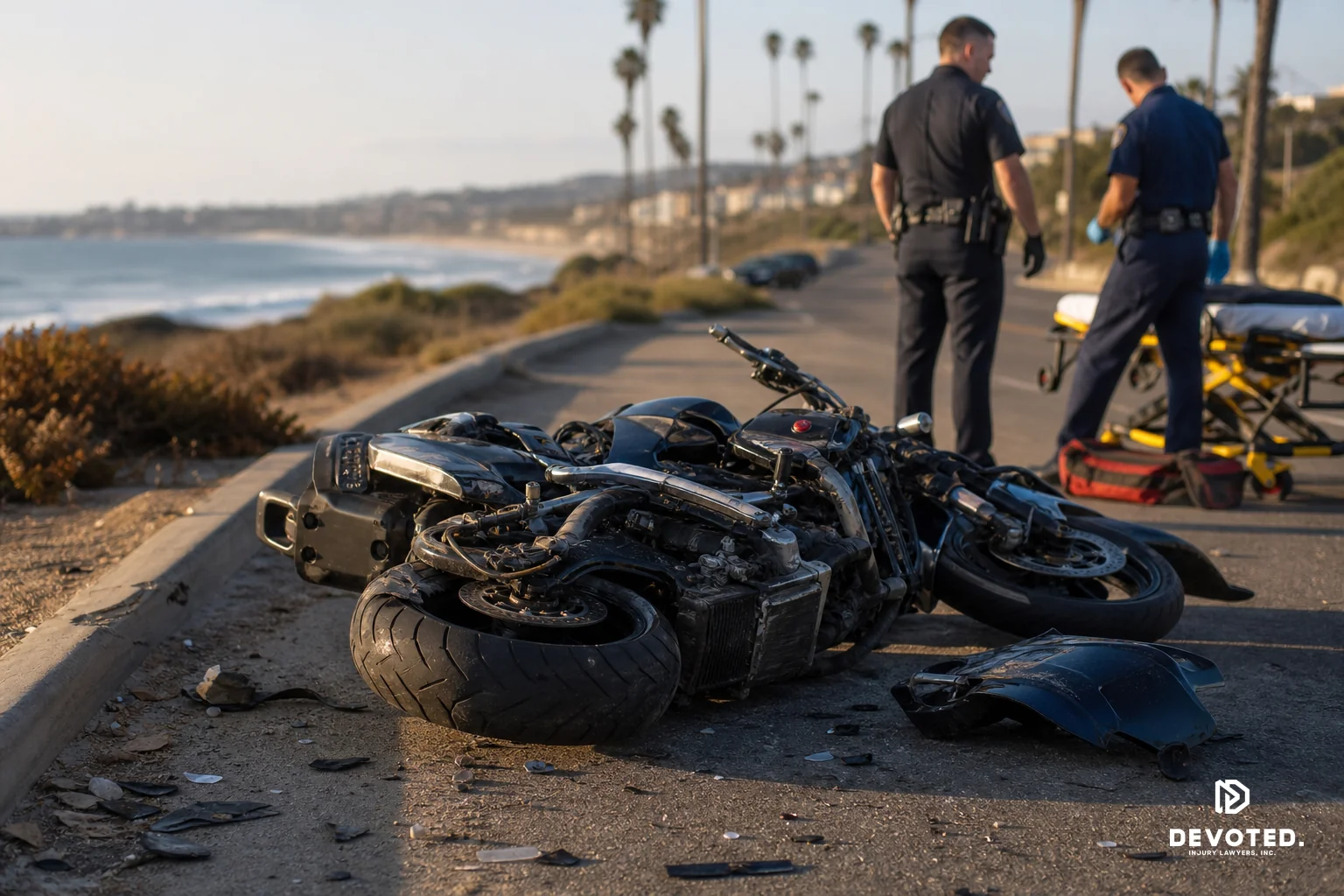
A motorcycle accident lawyer who focuses on rider cases typically brings deeper knowledge of insurer bias against motorcyclists, motorcycle-specific crash evidence, and injury severity than a general practice lawyer who handles a mix of legal matters. For riders hurt near Highway 78 or I-5 through Oceanside, that difference can affect how an insurance company values, and fights, a claim.
Key Takeaways
- Rider bias can be a factor: Insurance claims involving motorcyclists can involve disputes over fault that a rider may not expect.
- Injuries can be severe: A crash can leave a rider with a traumatic brain injury, road rash, or fractures, since a motorcycle offers none of the structural protection of a car. That can change how a claim should be valued and documented.
- Evidence disappears fast: Skid marks, gouge patterns, and nearby surveillance footage can be gone within days, so how quickly a lawyer acts matters.
- Both types of attorneys can be capable: A general practice lawyer isn't automatically the wrong choice, but they may need extra time to get up to speed on motorcycle-specific defense tactics.
- Ask direct questions before signing: How many motorcycle cases has the attorney actually handled, and how fast can the team get to the scene?
Motorcycle Claims at a Glance
| Factor | Motorcycle Accident Claims | Typical Car Accident Claims |
|---|---|---|
| Common insurer bias | Fault disputes can arise before all facts are reviewed | Fault typically judged on standard traffic evidence |
| Injury severity | Can be more severe (TBI, road rash, fractures) given the lack of a protective frame | Ranges widely, often less severe due to vehicle structure |
| Key physical evidence | Skid/gouge marks, bike damage, helmet and gear condition | Vehicle damage patterns, black box data, dashcam footage |
| California filing deadline | Generally 2 years from date of injury | Generally 2 years from date of injury |
| Government vehicle involved | Claim deadline can shrink to about 6 months | Claim deadline can shrink to about 6 months |
| Fee structure at Devoted Injury Lawyers | Contingency fee; no fee unless the firm recovers for you | Contingency fee; no fee unless the firm recovers for you |
| Minimum CA liability coverage | $30,000 per person / $60,000 per accident | $30,000 per person / $60,000 per accident |
Injuries in a motorcycle crash can be more severe than a typical fender-bender, which is why the choice between a lawyer who focuses on motorcycle cases and a lawyer who handles a broad mix of legal work is worth thinking through carefully.
Why Riders Often Ask This Question First
Motorcycle crashes along Highway 78, the 5 Freeway through Oceanside, and surface streets like El Camino Real tend to produce different outcomes than a typical car-on-car collision. A rider has no door, no airbag, and no crumple zone standing between them and the pavement. That physical reality shapes everything from the injuries a client suffers to how an insurance adjuster may react when the claim lands on their desk.
A claim can face pushback rooted in assumptions that motorcyclists are reckless. Where that occurs, it can show up as a lowball offer, an attempt to shift blame onto the rider for "not being visible enough," or a suggestion that lane position was somehow careless. A lawyer who focuses on motorcycle cases has generally seen these tactics before and knows how to respond with facts. A general practice attorney, without that repeated exposure, may need to research the pattern from scratch while the claim clock keeps running.
What a Lawyer Who Focuses on Motorcycle Cases Brings to a Claim
An attorney who has handled numerous motorcycle and other injury cases generally brings a few practical advantages to the table that go beyond simply knowing the law.
- Familiarity with rider-specific legal nuances: California allows lane splitting under California Highway Patrol safety guidelines, and an attorney familiar with motorcycle cases usually understands how that fact plays into a fault dispute rather than treating it as automatic evidence of recklessness.
- Recognition of common defense tactics: Insurers sometimes argue the rider wasn't visible, was traveling too fast for conditions, or contributed to the crash simply by being on two wheels. A lawyer who has faced this argument before can usually anticipate and address it early.
- Knowledge of what physical evidence actually matters: Skid marks, gouge patterns in the asphalt, the pattern of damage on the bike itself, and the condition of a helmet or riding gear can all speak to speed, impact angle, and fault in ways that aren't always obvious to someone unfamiliar with motorcycle dynamics.
- Working relationships with reconstruction experts: Motorcycle crash dynamics differ from car crashes in how the vehicle reacts on impact. An attorney experienced in these cases often knows which accident reconstruction professionals understand two-wheeled vehicle physics.
- Preparation for rider bias in negotiation: Rather than reacting to a lowball offer after it arrives, an attorney familiar with this dynamic can build the claim file from day one to address it.

What a General Practice Lawyer Brings Instead
A general practice attorney can still be a capable advocate. Many handle a wide range of matters, from contracts to family law to the occasional injury case, and that breadth isn't automatically a weakness. Some riders are perfectly well served by a trusted general practitioner they already know.
That said, a few gaps tend to show up in motorcycle-specific claims. A general practice lawyer may not have encountered the rider-bias argument often enough to recognize it immediately if an adjuster raises it. They may be less familiar with what evidence at a motorcycle crash scene is actually worth photographing or preserving, such as gouge marks versus simple skid marks, or how a helmet's impact pattern can support or undercut a claim. Because time-sensitive evidence like nearby surveillance footage or fading witness memory can disappear within days, a slower ramp-up period matters more than it might in a straightforward matter with a longer timeline.
None of this means a general practice attorney can't handle a motorcycle claim well. It does mean a rider should ask direct questions about relevant experience before signing anything, which we cover further down.
Motorcycle Accident Lawyer vs General Lawyer: Side-by-Side Comparison
| Comparison Point | Attorney Focused on Motorcycle/Injury Cases | General Practice Attorney |
|---|---|---|
| Experience with rider bias | Has generally encountered and addressed the argument before | May need to research the pattern as it comes up |
| Evidence collection speed | Often moves quickly to preserve skid marks, footage, and witness statements | Timeline can vary depending on caseload and familiarity |
| Reconstruction expert network | Typically has relationships with motorcycle-specific reconstruction professionals | May need to search for the right expert |
| Range of legal matters handled | Concentrated in personal injury case types | Broader, covering multiple areas of law |
| Insurance negotiation pattern recognition | Familiar with common lowball tactics used against riders | May approach negotiation with a more general framework |
| Fee structure | Often contingency-based, no fee unless there's a recovery | Varies by firm; ask directly |
The Injury Severity Factor
Riders involved in a crash can sustain severe injuries, sometimes more severe than an occupant of an enclosed vehicle would experience in a similar impact. Without a metal frame, airbags, or seatbelts absorbing the force, the body of a rider can take the brunt of a collision directly. That can mean traumatic brain injury, severe road rash, fractures, and lower-limb injuries requiring surgery, extended physical therapy, or long-term care.
This severity can affect claim value. Medical costs can run higher, recovery timelines can run longer, and the case for pain and suffering compensation may need thorough documentation to reflect what the injury actually costs a person physically and emotionally. Our detailed breakdown of how pain and suffering is calculated walks through the multiplier and per-diem approaches insurers and attorneys use, which matters even more in a case involving the kind of injuries riders can face.
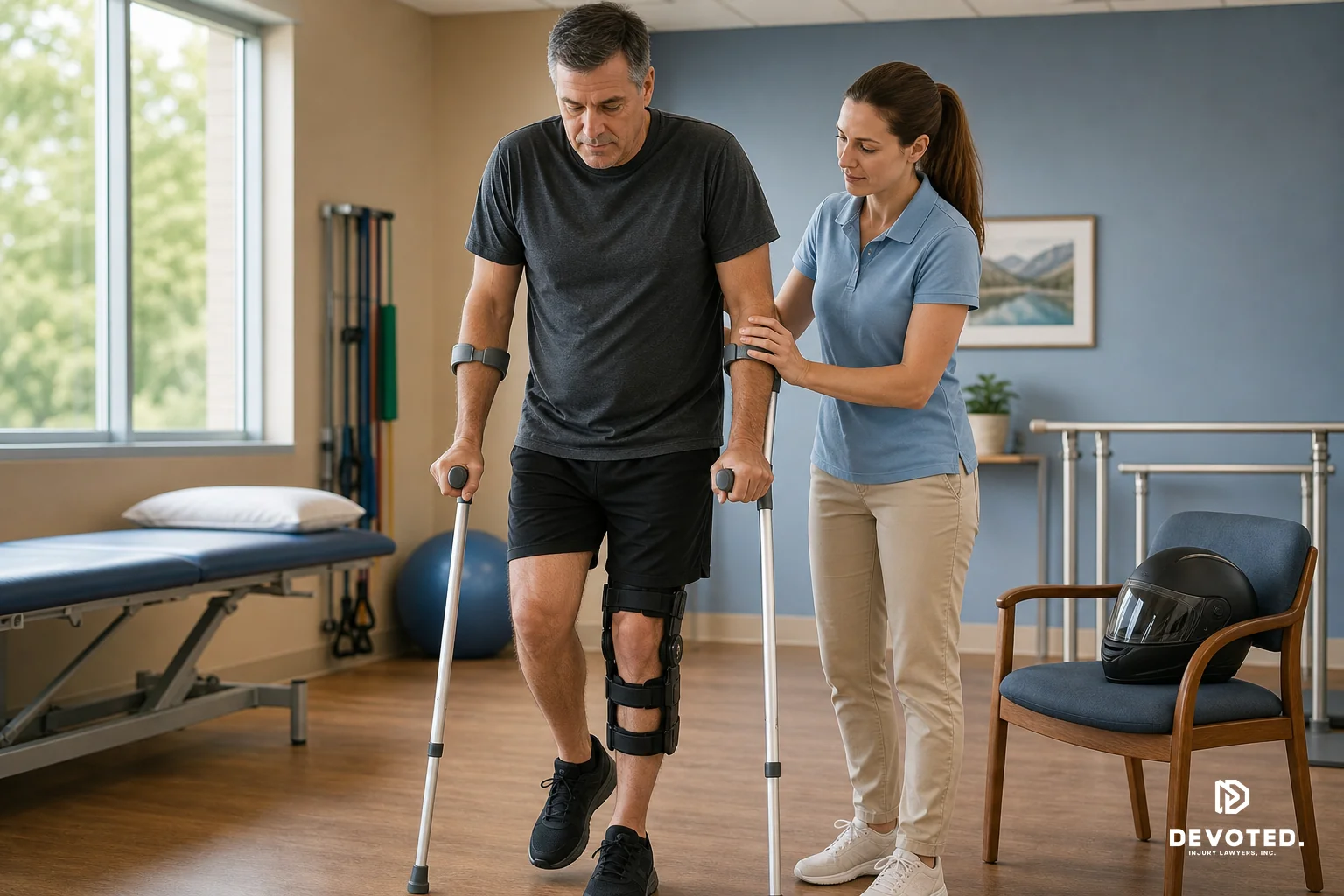
An attorney familiar with motorcycle injury patterns generally knows to bring in the right medical documentation early, from imaging records to specialist opinions on long-term impact, rather than treating the claim like a routine soft-tissue injury case. That distinction alone can factor into a settlement conversation months down the road.
Evidence That Matters Most in a Motorcycle Claim
Because motorcycle crash evidence tends to fade quickly, knowing what to preserve and how fast to act often shapes the outcome of a claim more than any other single factor. Key evidence usually includes:
- Skid marks and gouge patterns: These can indicate braking distance, impact angle, and speed at the time of the crash.
- Motorcycle damage and part failure: The specific pattern of damage to the bike can support or contradict a driver's version of events.
- Helmet and riding gear condition: Impact marks on a helmet or torn gear can corroborate the force and direction of the collision.
- Witness statements: Memory fades within days, so early outreach to bystanders matters.
- Surveillance and dashcam footage: Many businesses along Oceanside corridors and freeway on-ramps run security cameras that overwrite footage within a short window, sometimes as little as a week or two.
- Police and CHP reports: Official reports document initial statements, citations, and preliminary fault assessments.
If your case involves a government vehicle, such as a city maintenance truck or transit bus, the claim deadline can shrink dramatically. Our guide on the personal injury statute of limitations in California explains how the standard 2-year window compares to the roughly 6-month deadline for government claims, a distinction that catches many riders off guard.
Questions to Ask Before Choosing Representation
Whether you're leaning toward an attorney who focuses on injury cases or considering a general practitioner, a short list of direct questions can clarify who's the better fit for a motorcycle claim:
- How many motorcycle accident cases have you handled? Ask for a general sense of volume and outcome types, not specific settlement figures tied to other clients.
- How do you plan to address potential bias against riders with the insurance company? Listen for a concrete strategy, not a vague reassurance.
- What is your fee structure? Most personal injury representation in California runs on a contingency basis. For a full breakdown, see how much a personal injury lawyer costs in 2026.
- Do you or your team offer bilingual support? If English isn't your first language, ask directly rather than assuming.
- How quickly can you act to preserve evidence? Given how fast skid marks fade and footage gets overwritten, timing matters.
These same questions apply broadly to other injury claims too, including those covered in our guide on what to expect from a car accident lawyer in Oceanside and our overview of dog bite claims under California's strict liability law.
How Devoted Injury Lawyers Approaches Motorcycle Claims in Oceanside
Devoted Injury Lawyers, headquartered in Oceanside, handles motorcycle accident cases alongside eleven other California personal injury practice areas, including car accidents, truck accidents, rideshare accidents, bicycle and e-bike accidents, pedestrian accidents, slip and fall, dog bites, and wrongful death. That range means the firm brings pattern recognition from a broad set of vehicle and premises cases while maintaining focused attention on what makes motorcycle claims different.
Free case evaluations are available 24/7, and the firm works on a contingency-fee basis, meaning there's no fee unless there's a recovery. Service is available in English and Spanish, and the team can meet clients at home, in the hospital, or by video, which matters for riders dealing with mobility limitations after a crash. While based in Oceanside, the firm accepts California injury cases statewide, including San Diego, Los Angeles, Long Beach, Anaheim, Riverside, San Jose, Sacramento, Oakland, Fresno, and Bakersfield, and if your city isn't on that list, the firm still generally accepts California injury cases anywhere in the state.

If your situation involves a rideshare vehicle colliding with a motorcycle, our rideshare accident guide for Oceanside covers how liability questions shift when Uber or Lyft coverage enters the picture. And because minimum liability coverage in California is $30,000 per person and $60,000 per accident, a rider with severe injuries may need to look beyond the at-fault driver's policy limits toward underinsured motorist coverage or other sources of recovery.
Riders deserve a claim process that accounts for the physical reality of what happened to them, not a one-size-fits-all approach borrowed from a fender-bender file.
Frequently Asked Questions
Is a motorcycle accident claim different from a car accident claim?
Generally, yes. Motorcycle claims often involve more severe injuries, potential bias to address with insurers, and evidence types, like gouge marks and helmet damage, that don't come up in a typical car accident claim.
How long do I have to file a motorcycle accident claim in California?
Personal injury claims in California generally must be filed within 2 years of the date of injury. If a government entity or vehicle was involved, that window can shrink to roughly 6 months, so acting quickly matters.
What if the insurance company blames me for lane splitting?
Lane splitting is permitted in California under California Highway Patrol safety guidelines, and it isn't automatically evidence of fault. An attorney familiar with motorcycle cases can help present the facts of your specific situation rather than letting an assumption stand unchallenged.
What does it cost to hire a motorcycle accident lawyer in Oceanside?
Many California personal injury attorneys, including the team at Devoted Injury Lawyers, work on a contingency-fee basis, meaning there's no attorney fee unless the case results in a recovery. For more detail, see our guide on personal injury lawyer costs in 2026.
Should I talk to a lawyer even if I'm not sure who was at fault?
A free case evaluation can help clarify the situation before you commit to anything, and it costs nothing to have your case reviewed.
If you were hurt in a motorcycle crash near Oceanside, San Diego, or anywhere in California, the physical evidence and insurance clock are already moving. Get a free consultation to have your case reviewed, or call 24/7 at (888) 760-2LAW to talk through what happened. You can also submit your case details online when it's convenient for you, or learn more about the attorneys handling your claim by visiting our team page. If your bike needs repair while your claim moves forward, this list of reliable auto body shops can help you find a shop near you.
Prior results do not guarantee a similar outcome. - devotedlaw.com
Disclaimer: The information provided on DevotedInjuryLawyers.com is for general informational purposes only and does not constitute legal advice.
Jeff Yates, Esq.
CA Bar #332659 · Admitted 2021 · PI since 2011
Jeff is the founding partner of Devoted Injury Lawyers. He has worked in California personal injury since 2011 and holds a Justia 10.0 rating. He is the default legal reviewer for Devoted blog content.
Read Jeff's full bio →One call.
One team.
One less thing
to worry about.
Get a fast case evaluation. Free 24/7 consultation. No fee unless we win. Hablamos Español.