

5 Major California Truck Accident Case Examples & What We Can Learn
Navigating California's busy highways alongside large commercial trucks demands caution from each driver. From the I-5 corridor to the Grapevine, big rigs are a constant presence.

Navigating California's busy highways alongside large commercial trucks demands caution from each driver. From the I-5 corridor to the Grapevine, big rigs are a constant presence. When a collision occurs, the results can be catastrophic. At Devoted Injury Lawyers, we have seen the profound impact these incidents have on individuals and families. By examining significant truck accident cases in California, we can uncover valuable lessons that help protect our community and inform victims of their rights.
This article explores five key types of truck accident cases common in California, with a special focus on the heightened risks during the fall season when fog and rain create hazardous conditions. We will break down what went wrong and provide actionable advice if you ever find yourself in this challenging situation.
Why Truck Accidents Are More Complex
Collisions involving large trucks are fundamentally different from typical car accidents. A fully loaded semi-truck can weigh up to 80,000 pounds, while the average passenger car is about 4,000 pounds. This massive difference in weight and size means that truck accidents often lead to more severe injuries and intricate legal challenges.
These cases often involve multiple at-fault parties, including the driver, the trucking company, maintenance crews, and even the cargo loader. Navigating the web of federal and state regulations that govern the trucking industry, such as those from the Federal Motor Carrier Safety Administration (FMCSA), requires in-depth legal knowledge.
Case 1: Driver Fatigue on the I-5 Corridor
A tragic pre-dawn collision occurred when a truck driver, after being on the road for more than 12 hours, fell asleep at the wheel on Interstate 5. The semi-truck veered across several lanes and crashed into a family's SUV. The subsequent investigation revealed the driver had falsified their Hours of Service (HOS) logbook to hide the fact they had exceeded the legal driving limits.
- The Lesson: Driver fatigue is a primary, yet largely preventable, cause of major truck accidents. Trucking companies are legally responsible for monitoring their drivers and ensuring strict compliance with HOS regulations. Pressuring drivers to meet aggressive deadlines at the expense of public safety creates enormous liability.
- Actionable Advice: If a truck driver hits you, it's vital to have an attorney who can act quickly to preserve key evidence. This includes the driver's logbooks, dispatch communications, and electronic data from the truck’s onboard recorder, or "black box."
Case 2: Improper Cargo Loading near the Port of Long Beach
On a busy freeway connecting to the Port of Long Beach, a flatbed truck lost its load of unsecured construction materials while taking an exit ramp. The heavy materials spilled across the road, causing a dangerous multi-car pile-up. The investigation showed the cargo had not been secured according to federal safety standards, and the driver failed to perform an adequate pre-trip inspection.
- The Lesson: The responsibility for safe transport goes beyond just the driver. The company that loaded the cargo and the trucking company both have a duty to ensure much is properly secured. Improperly loaded freight can shift a truck’s center of gravity, making rollovers and spills far more likely.
- Actionable Advice: After an accident caused by falling debris or an overturned truck, document the scene as thoroughly as possible with photos and videos. Capturing images of the spilled cargo, the truck's position, and any tie-downs can become critical evidence.
Case 3: Brake Failure on the Grapevine in Fall Weather
As autumn brought rain to Southern California, a semi-truck's brakes failed on the steep, winding downgrade of the Grapevine on I-5. Unable to stop, the truck slammed into a line of cars slowed by the weather. A post-crash inspection uncovered severely worn brake pads and leaking hydraulic lines that the trucking company's shoddy maintenance records failed to disclose.
- The Lesson: Fall conditions demand that many vehicles, especially 80,000-pound trucks, are in perfect working order. Wet roads significantly increase stopping distances, and faulty brakes are a recipe for disaster. Trucking companies generally have a legal duty to perform regular, thorough maintenance and keep meticulous records. Neglecting this can be a serious breach of safety.
- Actionable Advice: Rarely assume the driver is a leading party at fault. An experienced legal team will dig into the truck's maintenance history, repair invoices, and inspection reports to determine if mechanical failure was a contributing factor.
Case 4: Speeding in Tule Fog in the Central Valley
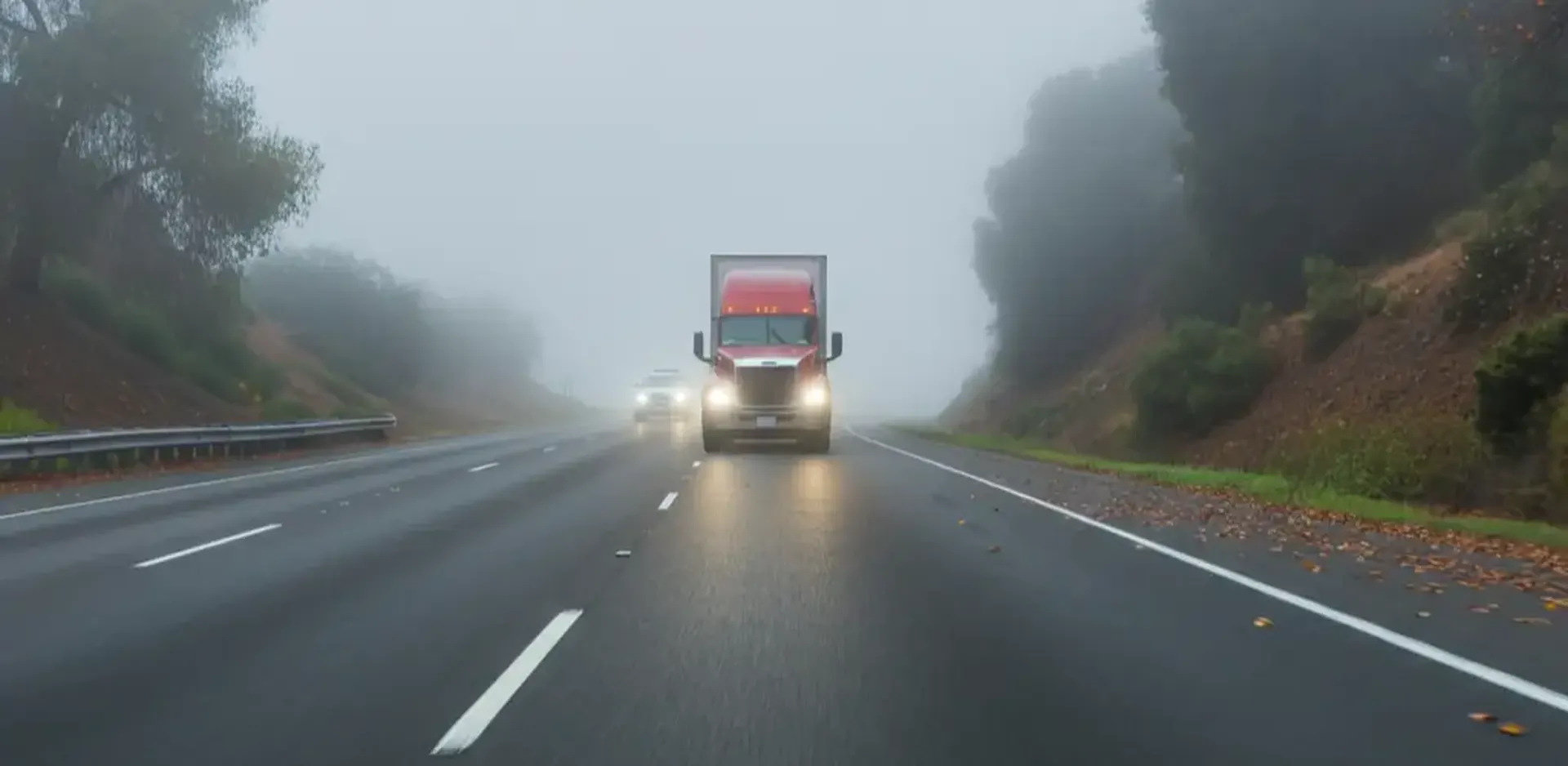
Early morning Tule fog, a common fall and winter hazard in the Central Valley, created near-zero visibility conditions. Despite posted warnings and reduced visibility, a tanker truck driver was traveling well over a safe speed for the conditions. The driver failed to see traffic that had slowed, resulting in a devastating chain-reaction crash.
- The Lesson: Commercial drivers are held to a higher professional standard and needs to adjust their driving for adverse conditions like fog, rain, or smoke from wildfires. Adhering to the speed limit is not enough; they need to reduce speed to what is safe and prudent for the current conditions.
- Actionable Advice: Witness statements are incredibly valuable in cases involving weather factors. If possible, get the contact information of other drivers or individuals who saw the accident. Their testimony about the visibility and the truck's speed can be crucial for your case.
Case 5: Distracted Driving in Downtown Los Angeles
A delivery truck in a congested urban area ran a red light and T-boned a sedan, causing severe injuries to the driver. Cell phone records, obtained by subpoena during the legal discovery process, proved the truck driver was sending a text message just seconds before the crash. This was a clear case of distracted driving and a blatant disregard for others' safety.
- The Lesson: Distracted driving is negligence. When the operator of a massive commercial vehicle does it, the behavior is exceptionally reckless. Most trucking companies have zero-tolerance policies against handheld cell phone use, and a violation can establish clear liability.
- Actionable Advice: If you believe the truck driver who hit you was distracted, report this to the responding police officers and your attorney. Legal professionals have the tools to subpoena phone records to prove whether the driver was using their device at the moment of the crash.
How long do I have to file a car accident claim in California?
For most California personal injury claims, including this category, the statute of limitations is two years from the date of the injury under CCP § 335.1. Government claims (against a city, county, or state agency) have a much shorter six-month window under Gov. Code § 911.2 - so do not wait to call.
What to Do After a Truck Accident in California
The moments after a truck accident are chaotic and frightening. Taking these steps can protect your health and your legal rights.
- Prioritize Safety: Check yourself and others for injuries and call 911 immediately. If you can, move to a safe location away from traffic.
- File a Police Report: Make sure law enforcement is called to the scene. An official police report is a critical piece of evidence.
- Document Much: Use your smartphone to take pictures and videos of the entire scene. Capture damage to many vehicles, skid marks, road conditions, and relevant traffic signs.
- Exchange Information: Get the truck driver's name, license number, insurance information, and the name of their trucking company. Also, note the truck’s license plate and any USDOT numbers visible on the cab or trailer.
- Seek Medical Attention: Even if you feel fine, you should be evaluated by a medical professional. Adrenaline can mask serious injuries that may not present symptoms for hours or days.
- Avoid Recorded Statements: Do not speak to the trucking company's insurance adjuster or provide a recorded statement before consulting an attorney. Their job is to protect their company's financial interests, not yours.
How Devoted Injury Lawyers Can Help
The cases above highlight the complex factors involved in truck accident claims. Successfully navigating these challenges requires a legal team with the resources and experience to stand up to large trucking corporations and their aggressive insurance companies.
At Devoted Injury Lawyers, we launch exhaustive investigations to uncover each cause, from driver error and poor maintenance to negligent hiring and supervision. We are committed to holding each responsible party accountable and securing the maximum compensation you deserve for your medical bills, lost income, and pain and suffering.
If you or someone you love has been injured in a truck accident in California, contact our team today for a free, no-obligation consultation. Let our dedicated attorneys fight for you.
What should I do today?
Take three steps right now: (1) get any needed medical care and follow through with each visit, (2) photograph injuries, vehicles, scene, and any property damage before it changes, and (3) call us before talking to the at-fault insurer. Call (888) 760-2LAW for a free, no-pressure consultation, or visit our contact page to send the details. We answer 24/7, work on contingency, and will tell you straight whether you might have a case. Past results do not guarantee a similar outcome.
Disclaimer: The information provided on DevotedInjuryLawyers.com is for general informational purposes only and does not constitute legal advice.
Jeff Yates, Esq.
CA Bar #332659 · Admitted 2021 · PI since 2011
Jeff is the founding partner of Devoted Injury Lawyers. He has worked in California personal injury since 2011 and holds a Justia 10.0 rating. He is the default legal reviewer for Devoted blog content.
Read Jeff's full bio →One call.
One team.
One less thing
to worry about.
Get a fast case evaluation. Free 24/7 consultation. No fee unless we win. Hablamos Español.