

Black Ice Car Accidents in California: What You Need to Know
California’s sunny reputation can make drivers complacent, but winter roads hold a hidden danger: black ice. This nearly invisible hazard contributes to serious car accidents each year, especially in mountainous regions and colder inland areas.

Quick answer: Under California law - specifically CCP § 335.1 - most personal injury claims have a two-year deadline from the date of injury (one year for medical malpractice, which we do not handle). Acting quickly preserves evidence, witness memories, and your right to recover medical bills, lost income, and pain and suffering. Devoted Injury Lawyers is a contingency-fee firm - you pay no fee unless we win.
California’s sunny reputation can make drivers complacent, but winter roads hold a hidden danger: black ice. This nearly invisible hazard contributes to serious car accidents each year, especially in mountainous regions and colder inland areas. A clear road can become a slippery trap in an instant, leading to devastating multi-car pileups and single-vehicle collisions.
Understanding the unique challenges of a black ice accident is crucial for your safety and your legal rights. At Devoted Injury Lawyers, we have seen firsthand how these incidents can turn lives upside down. This article will explain what black ice is, how to drive safely in icy conditions, and what steps to take if you are involved in a collision.
What is Black Ice and Why is it So Dangerous?
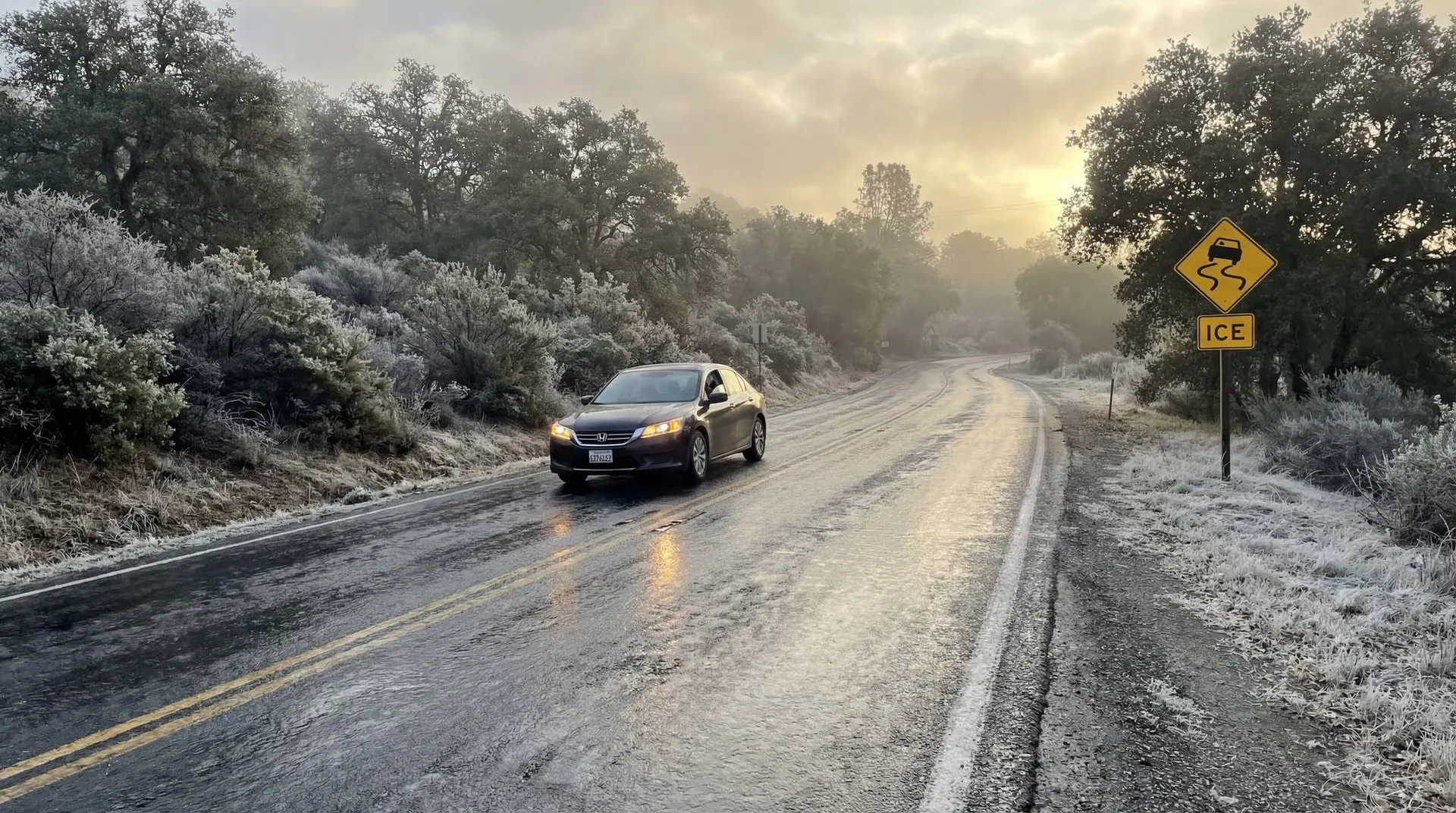
Black ice is a thin, transparent layer of ice that forms on road surfaces. It gets its name because it blends in with the dark pavement, making it almost impossible to see. Unlike snow or thicker ice, it doesn't look frosty or white. It often appears as just a wet patch on the road.
This deceptive quality is what makes black ice so treacherous. Drivers often have no warning before they lose traction, control, and the ability to steer or brake.
How Does Black Ice Form?
Black ice forms when the air temperature is at or just below freezing (32°F or 0°C), while the ground temperature is still slightly warmer. Light rain, drizzle, or melting snow can refreeze into a smooth, glossy sheet of ice on the roadway.
Common places to encounter black ice include:
- Bridges and Overpasses: These structures freeze faster than roads because cold air circulates above and below them.
- Shaded Areas: Sections of road that don't get direct sunlight, such as those under trees or along hillsides, stay colder longer.
- Tunnels: The entrance and exit points of tunnels are prone to rapid temperature changes.
- Low-Lying Areas: Cold air settles in valleys and dips in the road, creating ideal conditions for ice.
How long do I have to file a car accident claim in California?
For most California personal injury claims, including this category, the statute of limitations is two years from the date of the injury under CCP § 335.1. Government claims (against a city, county, or state agency) have a much shorter six-month window under Gov. Code § 911.2 - so do not wait to call.
Driving Safely in Icy Conditions
The best way to handle a black ice accident is to avoid one altogether. Prevention is key when roads may be icy. By adopting defensive driving techniques, you can significantly reduce your risk.
Tips for Staying Safe on the Road
- Slow Down: Speed is a major factor in the severity of black ice accidents. Reduce your speed significantly below the posted limit to give yourself more time to react.
- Increase Following Distance: Double or even triple your normal following distance. This provides a larger buffer if the car in front of you suddenly brakes or skids. A good rule of thumb is to maintain at least eight to ten seconds of space.
- Avoid Sudden Moves: Steer, accelerate, and brake gently and smoothly. Abrupt maneuvers can cause your tires to lose their grip on an icy surface.
- Know the Danger Zones: Be extra cautious on bridges, overpasses, and in shaded spots, especially during the early morning and nighttime hours when temperatures are lowest.
- Check Your Tires: Ensure your tires are properly inflated and have adequate tread. Worn tires have much less traction on ice.
- Stay Home if Possible: If the weather is particularly bad, the safest option is to avoid driving altogether. Check weather and road condition reports before you leave.
What to Do If You Hit Black Ice
Even the most careful drivers can find themselves skidding on black ice. If it happens, your reaction in those few seconds is critical.
- Do Not Slam on the Brakes: This is the most common and dangerous mistake. Hitting the brakes will lock your wheels and worsen the skid.
- Take Your Foot Off the Accelerator: Immediately ease off the gas pedal to slow the car down naturally.
- Steer into the Skid: Gently turn your steering wheel in the same direction that the rear of your car is sliding. If your back end slides to the right, steer to the right. This helps realign the car and regain control.
- Look Where You Want to Go: Your hands will naturally follow your eyes. Focus on the path you want to take, not the obstacle you are trying to avoid.
What to Do After a Black Ice Accident
If you are involved in a car accident on black ice, your priority is safety. However, the steps you take immediately following the crash can also protect your legal rights.
- Check for Injuries: Assess yourself and your passengers for injuries. If anyone is hurt, call 911 immediately.
- Move to a Safe Location: If possible, move your vehicle to the side of the road to avoid being hit by other cars. Turn on your hazard lights.
- Contact the Police: A police report is an essential piece of evidence. It will officially document the scene, conditions, and parties involved.
- Document Much: Take photos and videos of the accident scene, including vehicle damage, road conditions, and any visible ice. Note the weather, location, and time.
- Exchange Information: Get the names, contact details, and insurance information of many other drivers involved. Also, gather contact information from any witnesses.
- Seek Medical Attention: Even if you feel fine, see a doctor. Some injuries, like whiplash or concussions, may not show symptoms for hours or days. A medical record creates a link between the accident and your injuries.
- Do Not Admit Fault: Be careful what you say. A simple "I'm sorry" can be misinterpreted as an admission of guilt. Stick to the facts when speaking with police and other drivers.
Proving Fault in a Black Ice Accident Case
Determining liability in a black ice accident can be complex. While weather is a factor, it doesn't automatically absolve a driver of responsibility. A driver can still be found negligent if they were driving too fast for the conditions, following too closely, or otherwise operating their vehicle in an unsafe manner.
In some cases, a government entity or a private property owner may be partially liable if they failed to maintain the road, clear ice, or post adequate warnings about hazardous conditions.
The experienced attorneys at Devoted Injury Lawyers know how to investigate these complex cases. We work to gather crucial evidence, such as:
- Weather reports and road condition data
- Police reports and witness statements
- Photos and videos from the scene
- Expert testimony from accident reconstruction specialists
Our team is skilled at building a strong case to prove negligence and fight for the compensation you deserve for medical bills, lost wages, and pain and suffering.
Contact Devoted Injury Lawyers Today
Navigating the aftermath of a black ice car accident can be overwhelming. You need a dedicated legal team on your side to protect your interests and guide you through the process. At Devoted Injury Lawyers, we are committed to providing compassionate and effective representation for accident victims.
If you or a loved one has been injured in an accident involving black ice, don't wait. Contact us today for a free, no-obligation consultation to discuss your case. Let us handle the legal complexities so you can focus on your recovery.
What should I do today?
Take three steps right now: (1) get any needed medical care and follow through with each visit, (2) photograph injuries, vehicles, scene, and any property damage before it changes, and (3) call us before talking to the at-fault insurer. Call (888) 760-2LAW for a free, no-pressure consultation, or visit our contact page to send the details. We answer 24/7, work on contingency, and will tell you straight whether you might have a case. Past results do not guarantee a similar outcome.
Disclaimer: The information provided on DevotedInjuryLawyers.com is for general informational purposes only and does not constitute legal advice.
Jeff Yates, Esq.
CA Bar #332659 · Admitted 2021 · PI since 2011
Jeff is the founding partner of Devoted Injury Lawyers. He has worked in California personal injury since 2011 and holds a Justia 10.0 rating. He is the default legal reviewer for Devoted blog content.
Read Jeff's full bio →One call.
One team.
One less thing
to worry about.
Get a fast case evaluation. Free 24/7 consultation. No fee unless we win. Hablamos Español.